FTSE Russell Paper Looks at FX Impact on Investor Returns
Posted by Colin Lambert. Last updated: November 5, 2026
A new paper from LSEG’s FTSE Russell takes a look at the FX impact on global index returns, through the prism of the WMR Fix, highlighting the rise of tracking error when other rates are used by investors.
The paper notes that the FX rate used matters for asset owners and asset managers because the benchmarks define the reference point against which portfolio and delegated-manager performance is assessed. “Where an index embeds a specific FX rate, differences between that rate and the FX source used in portfolio valuation can create differences between portfolio and index returns even where the underlying securities are unchanged,” it observes.
The paper also notes how this issue also extends to execution. “If FX is transacted at rates materially different from the benchmark reference rate, realised portfolio returns can diverge from the index,” it states. “Part of the resulting active return may therefore reflect FX implementation rather than the underlying investment decision.”
The paper uses the FTSE World Government Bond Index (WGBI), in unhedged US dollar terms, at documents the annual bond and FX attributed returns across a 10-year period, and ask two questions. First, how important is FX to total index returns? Second, how much does the measured index return change when the FX conversion convention changes, either through the benchmark time or the FX rate source used?
It notes the FX contribution has varied materially through time and can account for a sizeable share of the unhedged index’s performance, at times contributing more than the bond component, peaking at 6.19% in 2017 (compared to 1.25% for bonds), and bottoming at -5.11% in 2022 (-14.66%). “FX does indeed matter for the return of the USD unhedged WGBI,” the paper states.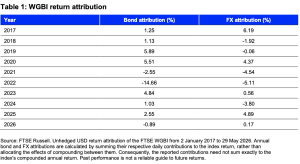
The paper gets into FX timing and source rates to look at tracking error in its second section by constructing a hypothetical (counterfactual) WGBI return series, in which the underlying bonds, country weights and local currency returns remain unchanged, while the timing and source of the FX rates are varied.
The study looks at other WM fixing rates versus the “closing” spot rate (London 4pm), as well as indicative point-in-time quotes using composite Reuters instrument codes. It finds that taking the FX observation one hour away from London 4pm produces an average absolute WGBI basis of just under 10 basis points, while the 95th-percentile basis is approximately 18–26 basis points depending on the reporting horizon. The magnitude of the basis increases as the timing gap widens, before broadly stabilising once the observation is around five hours or more from the 4pm, after which the average absolute basis is around 15-20 basis points, with the 95th percentile at 35-40bp.
The rate source effect is smaller, “but remains material for sufficiently large index exposures”, the study states. Using the indicative RICs at the same observation time produces an average absolute WGBI basis of approximately 2–2.5 basis points, rising to around 5 basis points at the 95th percentile.
The report highlights how the FX execution can have an impact on tracking error and manager performance assessment. It observes that while FX does have an impact, the findings do not imply that returns would be systematically altered. “Rather, it shows that inconsistent FX conventions can introduce a non-investment component into the measured active return and, in sufficiently close cases, alter whether a manager appears to have outperformed or underperformed the benchmark,” the paper states. “This matters for asset managers in understanding their own performance and asset owners in evaluating manager investment skill. Importantly, because the probability of a sign reversal depends on return differences rather than the size of the exposure, these implications are equally relevant for smaller funds.”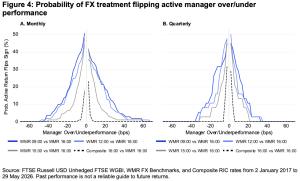
The paper concludes with two main points. First, it says that FX is an important component of the FTSE WGBI’s unhedged returns when measured in US dollars and can materially add to or detract from the underlying bond markets’ performance. Second, it says where an index references a specific FX benchmark, the choice of FX source matters.
It continues that using a different FX reference rate from the London 4pm WMR rate introduces the risk of deviations from the WGBI’s reported returns, even when the underlying bonds and country weights remain unchanged. These differences can affect measured portfolio performance relative to the index and can become significant over monthly, quarterly and annual reporting periods, leading to material over- or underperformance relative to a benchmark.
“For investors, the message is one of consistency and transparency,” the paper concludes. “Where WMR rates are embedded in a benchmark, understanding how FX is implemented, valued and measured relative to that benchmark is important for index tracking, manager assessment and performance attribution.”